

The U.S. Treasury published October Treasury International Capital (TIC) data, which includes foreign ownership of Treasurys (USTs). The UST holdings of foreign official institutions—mainly foreign central banks—continued to slowly decline in October such that they account for just under 13% of Treasurys outstanding, down from nearly 37% in 2010 (see below). The decline in their holdings was in longer-dated notes and bonds (rather than T-bills), also consistent with the recent trend.
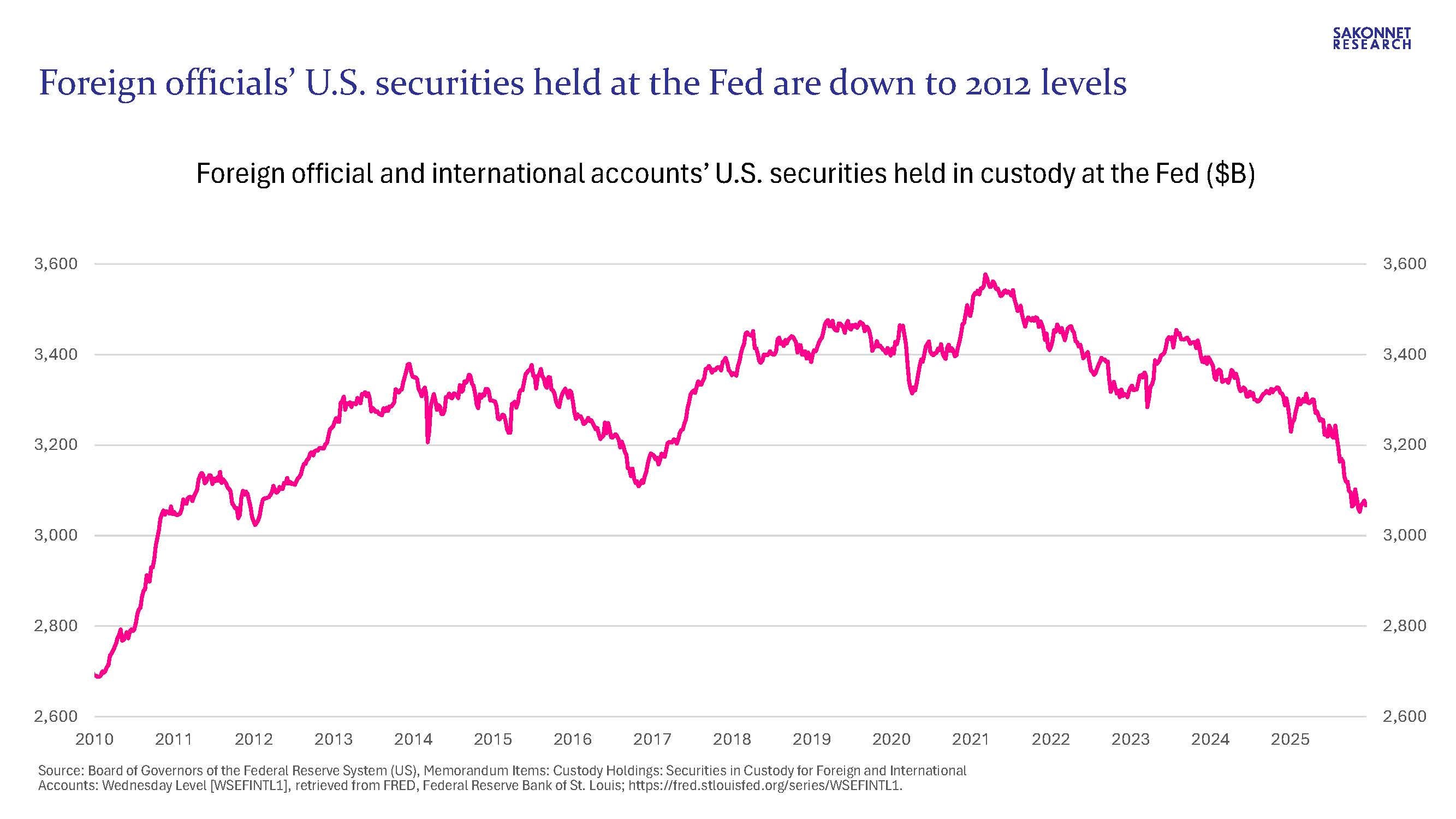
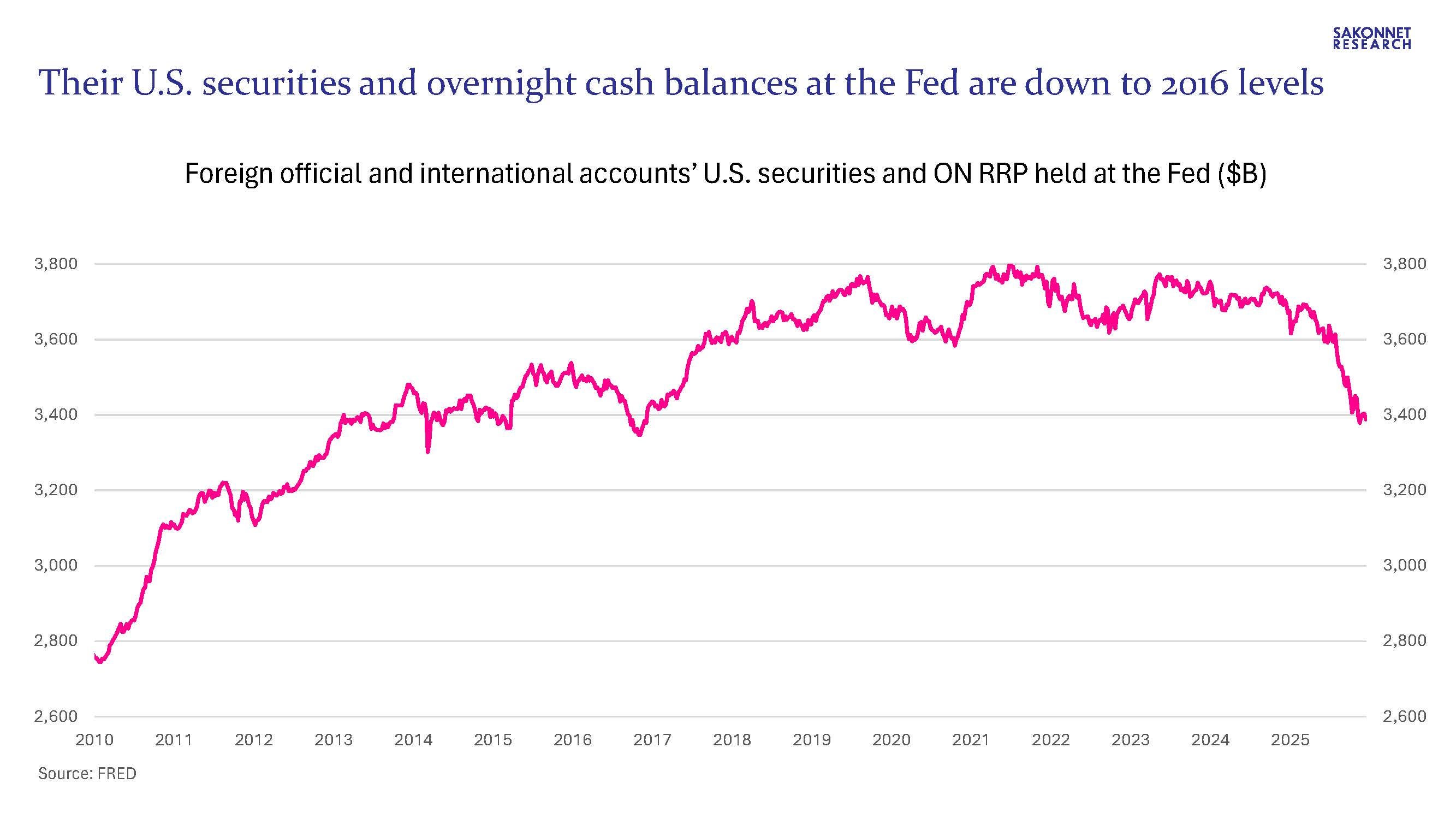
Foreign central banks are also pulling dollar-denominated assets out of the Federal Reserve: these entities’ U.S. dollar holdings (securities and cash) at the Fed are at their lowest level since 2016 (see below). Why? Either because they want to diversify out of U.S. assets or because they need the dollars in their (weak) domestic economies.
According to the TIC data, Japan, the United Kingdom and China are the three largest foreign holders of Treasurys by a comfortable margin, with the Cayman Islands well behind. However, a recent Fed paper (link) found that the TIC data likely severely undercounts Cayman Islands-domiciled hedge funds’ Treasury holdings, and that the Cayman Islands is in fact the largest foreign holder of Treasurys by a wide margin. The paper found that these hedge funds’ Treasury holdings have increased by a substantial $1 trillion since 2022, reaching $1.85 trillion by the end of 2024, and that these funds absorbed a whopping 37% of net issuance of longer-dated USTs (notes and bonds) from 2022 to 2024, nearly the same amount as all other foreign investors combined.
Given the absence of sizable buyers of longer-dated USTs other than Cayman Islands hedge funds putting on the highly leveraged Treasury cash-futures basis trade (financed with negative haircut Treasury repo in many cases), Treasury Secretary Bessent has gone from repeatedly criticizing his predecessor for relying too heavily on T-bill issuance to fund the government’s massive deficits to employing the same strategy that she did. Indeed, T-bills have accounted for nearly 90% of total UST issuance over the past five months.
Ostensibly for the purpose of maintaining ample bank reserves and ensuring the smooth functioning of money markets (even though the Fed’s own gauge updated today suggests that bank reserves remain abundant), the Fed just started buying what could be as much as $55 billion of T-bills per month through at least April. The Fed is doing much to help Treasury fund its deficits and limit its interest costs, as I wrote about here. And in so doing, it’s fueling an ever larger financial/asset bubble, with financial leverage at or near record highs in many cases.
Citigroup’s then-CEO Chuck Prince said his famous line in 2007 about as long as the music is playing (link), but less known is what he preceded that line with. “When the music stops, in terms of liquidity, things will be complicated.” Truer words have never been spoken, and they apply just as well to current conditions as they did to those that prevailed before the Great Financial Crisis.

The content in As the Consumer Turns newsletters should not be construed as investment advice offered by Adam Josephson. This market commentary is for informational purposes only and is not meant to constitute a recommendation of any particular investment, security, portfolio of securities, transaction or investment strategy. The views expressed in this commentary should not be taken as advice to buy, sell or hold any security. To the extent any content published as part of this commentary may be deemed to be investment advice, such information isn’t tailored to the investment needs of any particular person. No chart or graph provided should be used to determine which securities to buy or sell.